

Why Benchmarking Post-Trade Operations Matters for the Industry
Thursday, November 5, 2026
Most teams know their own process. Few knows how it compares.
Ask a post-trade team where their time goes and they’ll usually have a good answer. The confirmation that needed three emails to agree. The invoice rebuilt by hand. The nomination re-keyed from a chat message into the ETRM.
Ask how that compares with the rest of the industry, and the answer gets much harder. Is a day spent reconciling volumes normal, or a sign something is broken? Are your peers further ahead, or facing the same problems?
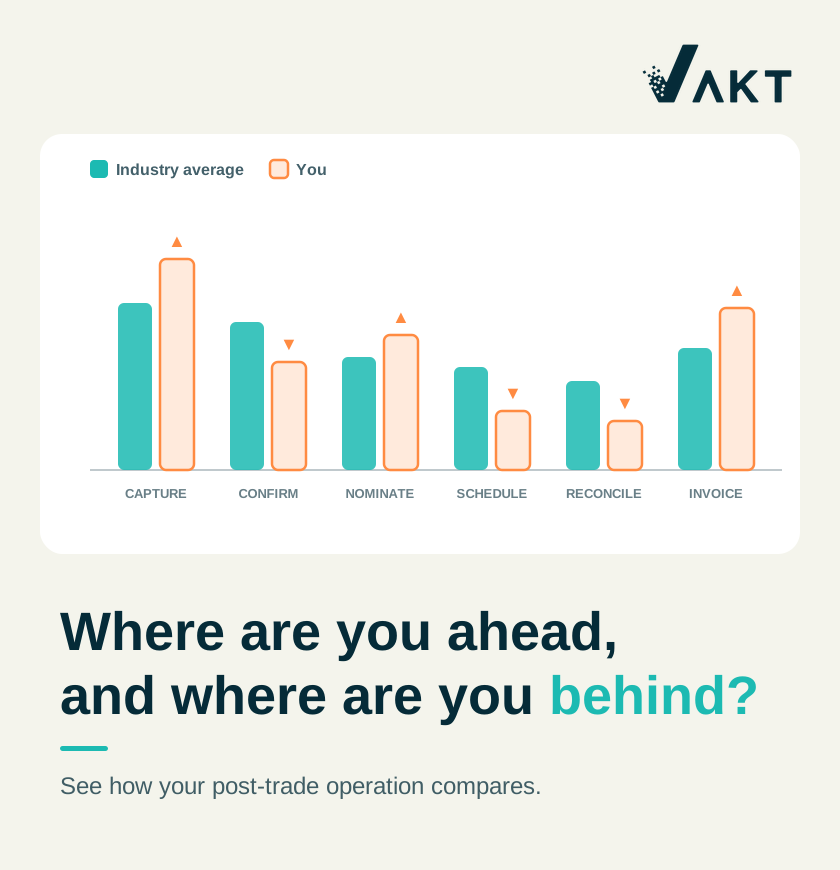
That is what benchmarking post-trade operations is for. It turns a feeling about how things are going into a clear picture of where you stand, and where the industry stands as a whole.
Why post-trade is hard to compare
Front office performance is measured constantly. Trading results, margins and positions are tracked to the minute. Post-trade rarely gets the same attention, even though it is where every trade is confirmed, scheduled, reconciled and invoiced.
Part of the reason is that post trade work is spread out. A single trade passes through confirmations, nominations, scheduling, actuals and invoicing, across several teams, systems and counterparties. Much of it still happens in email, chat and spreadsheets, so it is rarely measured in one place.
The other reason is that each firm describes it process in its own way. Without a common set of stages and a common way of scoring them, one firm’s number can’t be compared with another.
What a useful benchmark measures
A benchmark is only as good as what it measures. Ours looks at how post-trade actually runs day to day, using the same structure for every firm:
- Common stages: Each workflow is mapped to the same set of stages, from deal capture and confirmation through to final reconciliation and invoicing, so every firm is compared like for like.
- How each step is done: Every step is scored on a common scale, from fully manual through to human in the loop, human on the loop and human out of the loop.
- Where the time goes: We look at the touches per trade and the hands-on time spent at each stage, including what is still handled by email and spreadsheet.
- Hands on time versus waiting time: Time spent working on a trade is measured separately from time spent waiting on counterparties, because the two need very different fixes.
That last point matters. Automation can cut the time your team spends working on a trade. It does far less for time spent waiting on someone else. A good benchmark shows you which from which.
Why it matters for your firm
- See where you really stand: Find out how your post-trade operations compare with oil majors and trade houses, and where you’re ahead or behind.
- Find where the time goes: A benchmark shows which stage takes the most hands-on time, so you can see where manual work and re-keying are concentrated.
- Prioritise with evidence: Instead of trying to fix everything at once, you can focus on the stages where the gap is biggest and the gain is clearest.
- Build the case for change: Leadership teams respond to evidence. Showing how your process compares with peers is a far stronger case for investment than instinct alone.
Why it matters for the industry
Post-trade is shared work. Every confirmation has two sides, and every nomination involves terminals, inspectors and counterparties. When one firm relies on manual steps, its counterparties feel the effect too.
That is why an industry-wide view matters more than any single firms results:
- A shared picture: Firms can see which stages the industry has largely automated and which still depend on email, chat and spreadsheets.
- A common language: Using the same stages and the same scale fives the industry a consistent way to talk about post-trade maturity.
- Better conversations between counterparties: When both sides can see where the friction sits, it becomes easier to agree on what to fix together.
- Progress you can track: A benchmark sets a bassline the industry can measure itself against over time.
As AI and automation move further into post-trade, that baseline becomes more valuable. It shows where the real gains are, rather than where the hype is.
How our benchmark works
We’re running a benchmark of post-trade operations across oil majors and trading houses. Taking part is straightforward:
- A 30-minute call. We walk through your post-trade workflow with you, stage by stage.
- Your own results. You get access to your results, showing where your operation sits against the industry.
- The full industry report. Every participant receives a copy of the combined findings.
All responses are kept anonymous. No firm is named or identifiable in the report.
See where you stand
The more firms that take part, the clearer the picture becomes for everyone, including you.
Take part in our post-trade benchmark


