

The Strength Behind the Data: How VAKT Structures and Normalises Post-Trade data
Why post-trade data comes first
In our last post, we covered who VAKT is, where we come from and why the industry trusts us. This post looks at what sits underneath everything we do: post-trade data, and how we structure, normalise, validate and reconcile it.
Post-trade has long run on slow, paper-based processes that are open to loss, delay and error. Part of the cause is simply how trades are described. Internal systems and counterparties use different naming conventions for traded products, and those names often under-describe what is being traded.
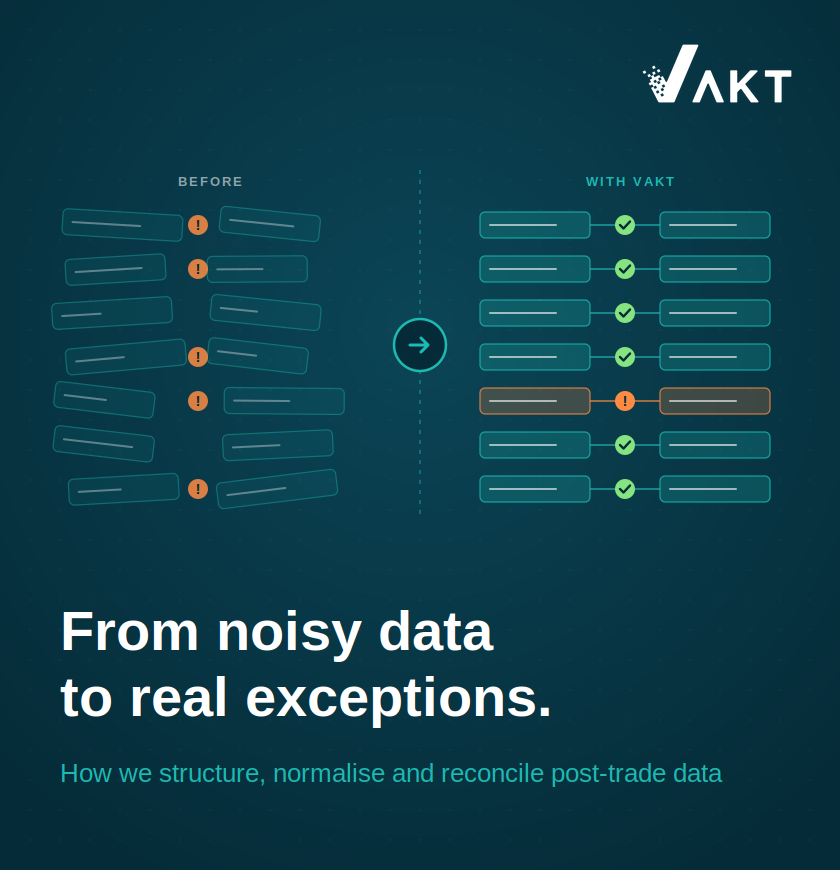
That is why, as we said at our Post Trade 2030 webinar, we aren't just using AI. We are building a system that is artificially intelligent, and that starts with the data. When two descriptions of the same trade don't line up, the mismatch looks like a discrepancy whether or not anything is wrong. Get the data right first, and what is left to flag is what actually matters.
Post-trade data from anywhere, in any shape
Post-trade data does not arrive in one tidy format. Trade recaps, contracts, confirmations, nominations, schedules and actuals come from many counterparties. Some are sent system to system. Many arrive by email or as documents, written in each sender's own layout and language.
We don't ask the market to change that. We take in post-trade data however it is sent, through APIs and native email, and we are not tied to one mode of transport, one format or one commodity. If it is post-trade data, structured or not, we can take it in.
How we structure post-trade data
We use a combination systemic data to turn unstructured post-trade data into structured data. Whether a confirmation arrives through a system integration or as an email, the result is the same: the trade details in a form that systems and people can work with.
In practice, the flow looks like this:
- Data comes in. Post-trade data arrives through APIs and native email, in whatever format the sender uses.
- We structure it. Systemic data mapping and AI turn it into structured trade data, whatever the source or commodity.
- Your systems stay current. Structured data updates your ETRM automatically and feed VAKT
Our APIs provide near real-time data and document updates across network participants, and you can configure the data feed into your own ETRM. Once connected, your systems are automatically updated with the latest, accurate details of a trade, which removes the need for manual keying.
How we normalise post-trade data
Structuring gets the details out. Normalising makes sure both sides mean the same thing by them. Without that step, two correct descriptions of one trade can still look like a discrepancy.
Our master data is the key. It gives both sides of a trade the same definitions to work from, and product data is a clear example. In 2023, together with SGS, we launched the VAKT Product Database (VPD), described as the first reference dataset for traded refined products and crude grades.
- One name per grade. VPD gives each grade a detailed quality specification and a unique name, covering about 3,140 grades across LPG, petrochemicals, distillates, residuals, base oils, biofuels, sustainable aviation fuel, and crudes and condensates.
- Built on recognised specifications. Each grade carries its relevant specifications, such as EN 228, EN 590 and ISO 8217.
- Kept current. We maintain VPD with the industry and inspectors so it keeps reflecting traded grades globally.
- Fits existing systems. You can replace your products database with VPD or map to it.
With the data structured and normalised, comparison becomes like for like. vSure compares trade terms algorithmically, pairs trades, detects discrepancies, and supports resolving them through secure communication.
How we validate and reconcile post-trade data
Structured, normalised data still has to be checked before anyone can rely on it. We validate post-trade data against other sources, identify discrepancies and enable reconciliation across systems and counterparties
- Trade confirmations. vSure compares trade terms algorithmically, pairs trades, detects discrepancies and supports resolving them through secure communication.
- True-up data and invoicing. vActuals brings all true-up data and invoicing into the same structured, reconciled view.
Because both sides work from the same structured and normalised data, a flag means a genuine difference in the trade, not a formatting mismatch. That is how trade data reconciliation cuts noise instead of adding it.


