

From Data to Action: How AI Agents Cut the Noise in Post-Trade
Tuesday, November 3, 2026
How AI agents in post-trade turn trusted data into fewer clicks and fewer false alarms
Why structured data is only the starting point
In our last blog, we looked at how we structure, normalise and reconcile post-trade data so that only real discrepancies get flagged. But clean data on its own doesn't save anyone time. The value comes from what happens next: who acts on it, how quickly, and how many steps it takes to get there.
This post looks at that next step. It covers how we turn trusted post-trade data into outputs your team can use, and how AI agents in post-trade take on the repetitive work that creates noise in the first place.
From data to action
We think about automation as a spectrum. Each step builds on the one before it:
- Read. Take in post-trade data from any source, in any format.
- Understand. Structure it so every field means the same thing on both sides of a trade.
- Compare. Check it against other sources and counterparties to find genuine differences.
- Recommend. Suggest what should happen next, such as an update, a reply or a correction.
- Act. Carry out the routine work, so your team's time goes on the exceptions.
Each step only works if the one before it is reliable. An agent that acts on inconsistent data just makes mistakes faster. That is why everything we do starts with trusted data.
Where our AI agents do the work
Our agentic AI platform has eight specialised agents. Rather than one general-purpose AI trying to do everything, each agent handles a specific part of post-trade work, across nominations, documents, contracts, email, anomaly detection and reporting.
Because each agent has a defined job and works from structured, validated data, its output is consistent and traceable:
- Full audit trail. Every action is recorded, so you can see what was done, when and why.
- Permanent knowledge capture. Playbooks capture how your team handles each situation, so that know-how stays in the business rather than leaving with people.
What that looks like in practice
These are the kinds of tasks we see across the industry, and the kind of work our agents are built to take on:
- Invoicing. Generating a single invoice can take an operator hours and around 30 clicks.
- Reporting. At one firm, a single demurrage report needed 50 touchpoints across four departments and three systems.
- Reconciliation. Another firm spent three to four days every month reconciling pipeline reports.
- Re-keying. At one producer, every incoming forecast, schedule or confirmation triggered the same details being re-keyed by hand across the ETRM, pipeline-nomination spreadsheets, and the pipeline operator’s system.
In each case, the problem isn't one difficult decision. It's dozens of small, manual steps: finding the right document, re-keying the same figures, checking them against another system, chasing a reply. Those steps are where errors creep in, and where the noise comes from.
With structured, validated data underneath, agents can do the gathering, comparing and drafting. Your team's time goes on the exceptions that need a person, instead of on building every report and invoice by hand.
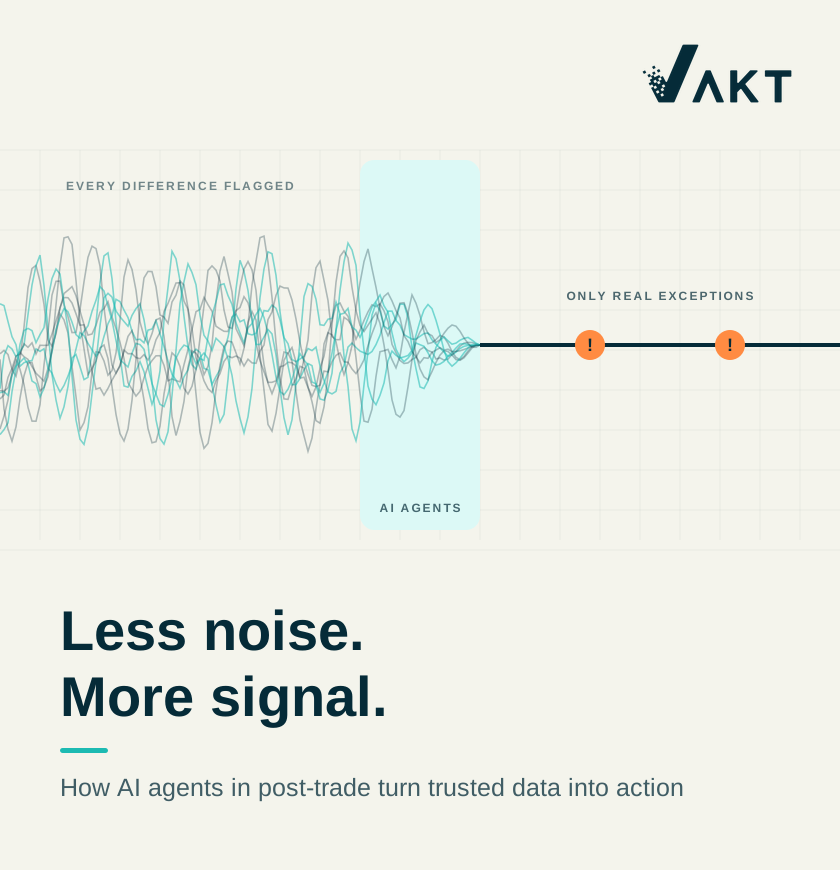
Less noise, more signal
Anomaly detection is where AI agents in post-trade pay off most, because they work from trusted data. When data has been structured and normalised first, an anomaly means something has genuinely changed or gone wrong, not that a counterparty used a different template or naming convention.
Fewer false alarms changes how teams work. When an alert reliably points to a real issue, people trust it and act on it quickly. The result is a shorter queue of exceptions that actually matter, rather than a long list of differences someone has to check one by one.
What AI agents in post-trade deliver
Indicative figures from early deployments show a 40 to 70% reduction in manual operations tasks and more than 90% fewer nomination errors.
Getting started
We work alongside your ETRM as an operational engine, so there's no need to replace the systems your team relies on. Onboarding can happen within two weeks.
See what our AI agents could take off your team's plate. Book a walkthrough
Want to see how your operation compares first? Take part in our industry benchmark.


